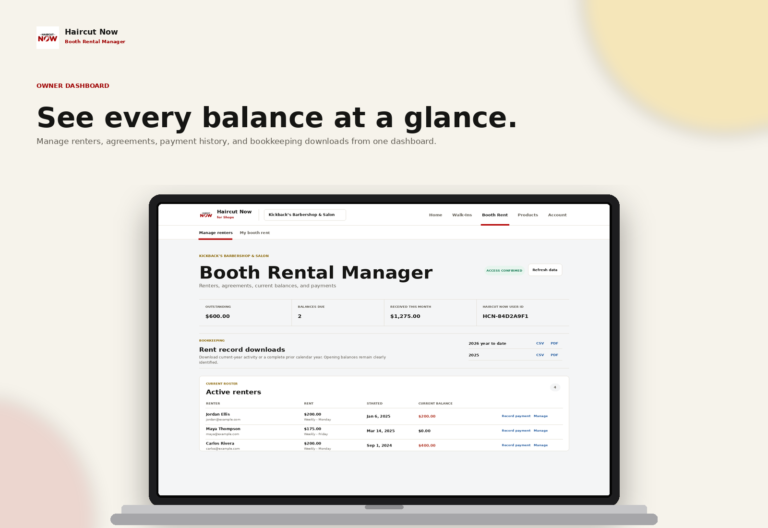
If you run a booth-rent shop, the weekly numbers that matter are usually the ones that tell you whether the floor is moving smoothly, whether walk-ins are being handled fairly, and whether rent is getting collected on time. The best barbershop operations metrics are simple enough to review in one sitting and specific enough to help you spot problems before they become missed revenue or frustrated renters.
For many owners, that means separating three different workflows: the walk-in queue, booked appointments in your own scheduling system, and rent tracking for independent chairs. Haircut Now’s Shop Operations bundle is built around that kind of separation, combining Walk-In Manager and Booth Rental Manager in one account for one location.
What a useful weekly scorecard should cover
A good weekly review does not need a giant dashboard. It needs a few numbers that answer practical questions: Are walk-ins moving? Are customers waiting too long? Are booked appointments filling the day? Are renters current on their balances?
For booth-rent owners and managers, a basic weekly scorecard usually includes:
- Walkout rate for walk-in customers who leave before getting served
- Average wait time or at least the wait pattern by busy day or hour
- Booked appointment volume from your separate appointment system, if you use one
- Rent balances and any partial or missing payments
- Participation level for renters who are checked in and taking walk-in offers
The key is to review each number in the right bucket. A shop can have a healthy walk-in line and still have rent issues. It can also have steady booked appointments and still lose walk-ins if the queue is moving too slowly.
Track walkouts separately from normal traffic
Walkout rate is one of the clearest signs that your walk-in experience needs attention. If customers are leaving because the wait feels too long, the issue might be staffing coverage, slow turnaround, poor communication at the kiosk, or simply a busy day that needs better planning.
With Walk-In Manager, the shop owner sets up the system once, and then the daily walk-in rotation runs automatically. Customers enter their names at the kiosk, eligible staff members receive mobile offers in fair round robin order, and the system advances the queue as offers are accepted or passed. That makes it easier to review whether walkouts are happening because the shop is overloaded or because the flow needs to be adjusted.
General advice: if you see repeated walkouts on the same day or time block, compare that pattern with your busiest walk-in windows and your staffing coverage for those hours.
Measure wait time in the context of the whole day
Wait time is not just a customer-service number. It also tells you whether your chair flow matches demand. A short wait can mean the shop is moving well, but it can also mean you are underusing capacity if the lobby stays empty. A long wait may be acceptable during peak traffic, but it should not become the default.
Because Shop Operations includes walk-in management rather than shop-wide booking, it helps to look at wait time as its own metric instead of mixing it with scheduled services. That keeps your review honest. Walk-ins belong to the kiosk queue. Booked appointments belong to your appointment system. Rent belongs to your booth-rent ledger.
If you already use an external appointment tool, keep using it. The point is to compare the three activity streams side by side, not force them into one workflow.
Review booked appointments as a separate calendar metric
Booked appointments matter even in a booth-rent shop that relies heavily on walk-ins. They can show which days are pre-filled, which barbers are in demand, and whether your shop has a healthy mix of scheduled and same-day traffic.
But scheduled bookings should stay separate from walk-in queue numbers. A booked slot is not the same thing as a kiosk walk-in, and it should be measured differently. A weekly review might ask:
- How many appointments were completed?
- Which days had the strongest advance demand?
- Did any booked services overlap with your busiest walk-in periods?
That separation matters because a shop can have good booked volume and still have weak walk-in handling. Or it can have a smooth walk-in line and uneven appointment demand. Looking at both helps you see the real shape of the week.
Watch rent balances every week, not just at month-end
Rent tracking is a different kind of metric from customer flow, but it deserves the same weekly attention. In a booth-rent shop, rent balances affect cash flow, planning, and accountability. Owners need to know who is current, who has made partial payments, and which agreements still need attention.
Booth Rental Manager is built to track booth-rent agreements, balances, and externally received payments. The renter has a private view, and the owner or manager confirms actual receipt. That makes the weekly review cleaner because you are looking at real balances instead of trying to reconstruct them from scattered notes.
If your shop has multiple renters, a weekly rent review can help you catch small issues before they turn into month-end cleanups. It is much easier to resolve a missing payment early than to sort out several weeks of backtracking later.
A simple weekly routine for shop owners
- Review the walk-in queue summary for volume, passes, and walkouts.
- Check wait patterns for the busiest times and days.
- Pull your appointment numbers from your separate booking system, if you use one.
- Confirm rent balances and note any partial or missing payments.
- Look for one action item for the next week, such as a coverage adjustment or a rent follow-up.
This routine is especially useful in shops where the owner does not want to spend the week manually coordinating every walk-in. Shop Operations is designed so the owner sets the system up, then the daily walk-in rotation keeps moving without regular receptionist-style work. That leaves you with a weekly review, not a constant operational burden.
How the bundle helps a booth-rent shop stay organized
Shop Operations combines Walk-In Manager and Booth Rental Manager in one one-location bundle, with unlimited applicable participating staff and renters. That gives an owner a practical way to separate the two most important shop jobs: keeping the walk-in floor moving and keeping booth-rent records clear.
It is also a good fit for shops with independent professionals who keep their own clients, tools, and payment methods. You can use the shared shop tools without trying to turn the whole operation into one unified employee system. That is often the real pain point for booth-rent owners: too many moving parts, not enough clean reporting, and too much manual coordination.
If your goal is to understand what is happening each week without micromanaging the floor, this bundle gives you the structure to do that.
See current Shop Operations pricing and start the free trial.
FAQ
What should a booth-rent owner measure every week?
At minimum, review walkout rate, wait time, booked appointment volume from your separate scheduling system, and rent balances for every renter.
Should I combine walk-ins and appointments in one metric?
No. Walk-ins, booked appointments, and rent tracking serve different purposes. Keeping them separate makes it easier to see where the shop is strong and where it needs attention.
Does Shop Operations include shop-wide booking?
Shop Operations combines Walk-In Manager and Booth Rental Manager. If you already use an independent appointment solution, you can keep it and still use the shop operations tools.
What is the fastest weekly win for most owners?
Start by reviewing walkouts and rent balances together. Those two numbers often reveal whether the issue is floor flow, customer wait experience, or collections follow-up.