
When men sit in the barber chair, one of the most common requests is simple:
“I want it shorter on the sides, but not too short.”
That sounds easy, but without clear communication, “short” can mean something completely different to every barber and every client. That is where the 3:2:1 rule for haircuts comes in.
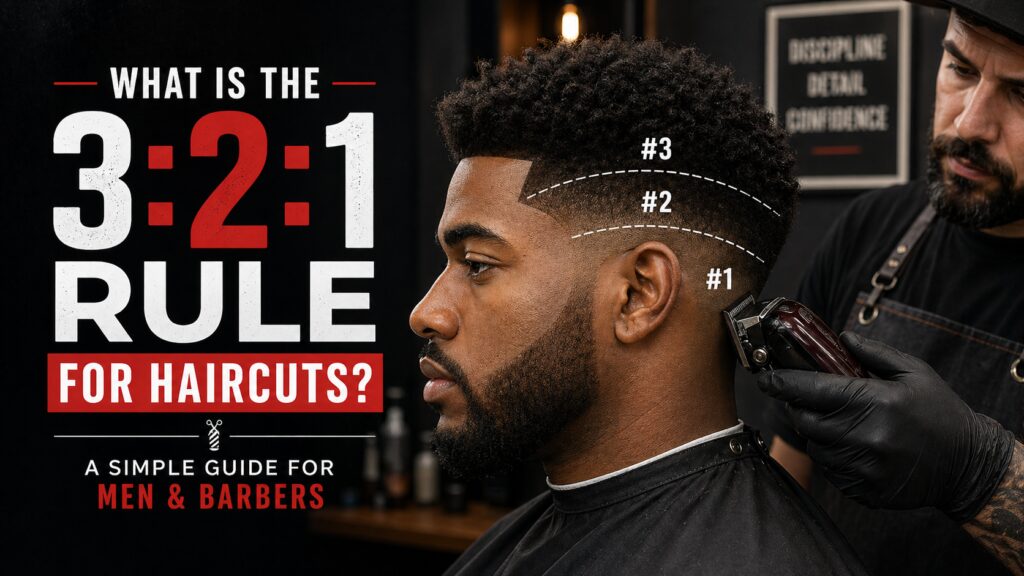
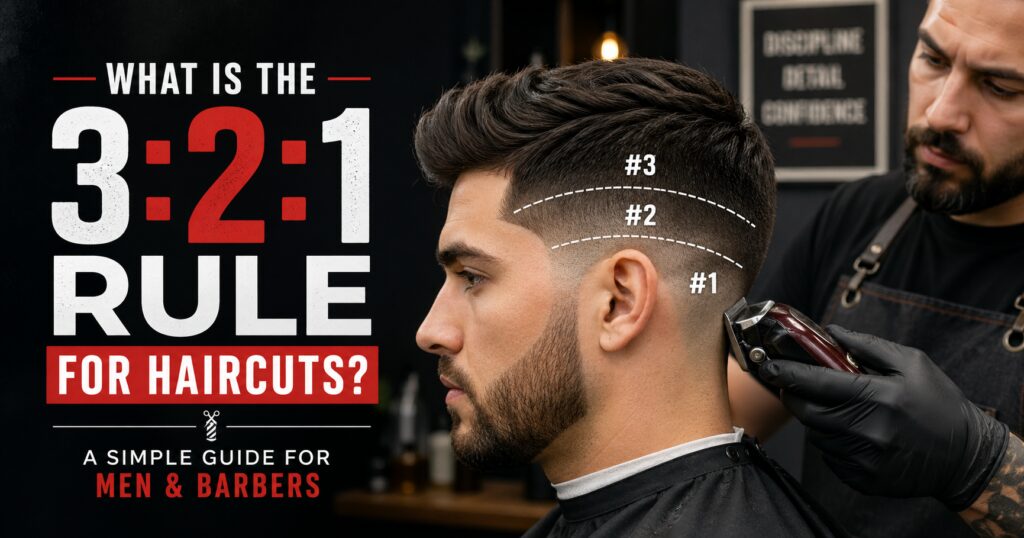
What Is the 3:2:1 Rule for Haircuts? The 3:2:1 rule is a simple haircut guideline that uses clipper guard numbers to create a clean, balanced taper or fade. It usually means using a #3 guard higher on the sides, a #2 guard in the middle, and a #1 guard near the bottom around the neckline and sideburn area.
For men, it is a great way to ask for a neat, professional haircut without going too extreme. For barbers, it is a simple system for blending the sides while keeping the haircut natural, masculine, and easy to maintain.
What Does the 3:2:1 Rule Mean?
The 3:2:1 rule refers to using three different clipper guard lengths on the sides and back of the head:
- #3 guard near the top of the sides
- #2 guard in the middle section
- #1 guard near the bottom
Each number represents a clipper guard size. The lower the number, the shorter the hair.
A basic 3:2:1 haircut gradually moves from longer hair near the top to shorter hair near the neckline. This creates a clean transition instead of one harsh line.
How Long Is Each Guard?
Here is a simple breakdown:
| Clipper Guard | Approximate Length | Common Use |
|---|---|---|
| #1 Guard | 1/8 inch | Bottom of taper, neckline, sideburns |
| #2 Guard | 1/4 inch | Middle blend area |
| #3 Guard | 3/8 inch | Upper sides, softer transition into the top |
The exact result can vary depending on the clipper brand, the barber’s technique, the client’s hair texture, and whether the barber cuts with or against the grain.
Why the 3:2:1 Rule Works
The 3:2:1 rule works because it follows the natural shape of the head. Hair is left longer near the top, where it needs to connect with the haircut style, then gradually gets shorter as it moves down the sides and back.
This creates a haircut that looks clean without being too aggressive.
For many men, this is the perfect middle ground between a regular haircut and a fade. It gives a fresh appearance, but it does not expose too much skin.
Is the 3:2:1 Rule the Same as a Fade?
Not exactly.
A 3:2:1 haircut can create a faded look, but it is usually softer than a true skin fade or bald fade.
A fade often goes down to a very short length, sometimes using no guard, a trimmer, or a shaver. The 3:2:1 rule usually stops at a #1 guard, which means some hair is still left at the bottom.
That makes it a good choice for men who want a clean haircut but do not want the sides taken down to the skin.
Who Is the 3:2:1 Haircut Good For?
The 3:2:1 rule works well for many men because it is clean, simple, and not too extreme.
It is especially good for:
Men who want a professional haircut for work.
Men who want a cleaner look without a bald fade.
Men with straight, wavy, curly, or coily hair.
Younger men who want a neat school haircut.
Older men who want a classic masculine style.
Barbers who need a simple starting point for a clean taper or basic fade.
This haircut can be adjusted depending on the client’s style. The top can be left longer, trimmed with scissors, textured, combed over, brushed forward, or shaped into a crop.
What Should Men Ask Their Barber For?
A client can say:
“I want a 3:2:1 on the sides and back, blended into the top.”
That tells the barber the general length pattern. However, the client should still explain how they want the top and neckline finished.
A better request would be:
“Give me a #3 near the top of the sides, blend into a #2, then a #1 around the bottom. Keep the top long enough to style, and taper the neckline.”
This gives the barber a much clearer picture.
What Barbers Should Know About the 3:2:1 Rule
For barbers, the 3:2:1 rule is not a strict formula. It is a starting point.
The barber still has to customize the haircut based on:
Head shape.
Hair density.
Hair texture.
Growth pattern.
Cowlicks.
The client’s preferred style.
How high or low the client wants the taper.
The biggest mistake is treating the 3:2:1 rule like three hard sections with obvious lines. The goal is not to create three separate bands of hair. The goal is to create a smooth transition from #3 to #2 to #1.
How a Barber Might Cut a 3:2:1 Haircut
A barber may approach it like this:
First, the barber establishes the lower area with a #1 guard around the neckline, sideburns, and lower sides.
Next, the barber uses a #2 guard through the middle area to begin the blend.
Then, the barber uses a #3 guard higher on the sides and back to connect the haircut into the longer hair on top.
After that, the barber blends between each section using clipper-over-comb, lever adjustments, half guards, corner work, or detail trimming.
The final step is usually the lineup, neckline, sideburn cleanup, and any scissor work or styling on top.
3:2:1 Haircut vs. 4:3:2 Haircut
A 3:2:1 haircut is shorter and cleaner.
A 4:3:2 haircut leaves more length on the sides and gives a fuller, more conservative look.
Here is the difference:
| Haircut Rule | Look | Best For |
|---|---|---|
| 3:2:1 | Shorter, cleaner, sharper | Men who want a fresh taper or basic fade |
| 4:3:2 | Fuller, softer, more conservative | Men who want a business-style haircut with more coverage |
If a man is nervous about going too short, a 4:3:2 may be a safer option. If he wants a cleaner and more noticeable haircut, the 3:2:1 rule may be better.
Is a 3:2:1 Haircut Good for Black Men’s Hair?

Yes, the 3:2:1 rule can work very well on coily, curly, and textured hair.
For textured hair, the barber may need to adjust the guards based on how tightly the hair curls and how dark or light the blend appears. A #1 on one person may look darker or lighter than a #1 on someone else because of hair density, curl pattern, and scalp contrast.
For Black men’s haircuts, the 3:2:1 rule can be used with:
Low tapers.
Temple tapers.
Afros.
Waves.
Curls.
Sponge twists.
Short even cuts.
Beard blends.
The key is making sure the blend matches the client’s desired look and does not remove too much weight from areas that need shape.
Is a 3:2:1 Haircut Good for Straight Hair?
Yes. On straight hair, the 3:2:1 rule creates a clean, even transition. However, straight hair can show lines more easily, especially if the hair is thick or dark.
That means the barber may need to spend extra time blending between the guards so the haircut does not look choppy.
For straight hair, a 3:2:1 cut works well with:
Side parts.
Comb overs.
Crew cuts.
Ivy League cuts.
Textured crops.
Short quiffs.
Classic business cuts.
Is the 3:2:1 Rule Good for Kids’ Haircuts?
Yes, the 3:2:1 rule is a great option for boys’ haircuts because it is clean but not too extreme.
Parents often want a haircut that looks neat for school, photos, sports, and everyday life. A 3:2:1 haircut gives a fresh look without going down to the skin.
It also grows out more naturally than a skin fade, which can start looking grown out quickly after just a few days.
How Often Should You Get a 3:2:1 Haircut?
Most men should get a 3:2:1 haircut every 2 to 4 weeks, depending on how sharp they want to keep it.
If you like a very fresh look, every 2 weeks is best.
If you are okay with a more natural grow-out, every 3 to 4 weeks may be fine.
Men with faster-growing hair or very sharp lineups may need more frequent maintenance.
How to Maintain a 3:2:1 Haircut
A 3:2:1 haircut is easy to maintain, but a few simple habits help keep it looking better between appointments.
Brush or comb the hair daily, depending on the style.
Use a light styling product if the top needs control.
Keep the neckline clean if you know how to do it safely.
Wear a durag or wave cap if maintaining waves.
Avoid waiting too long between cuts if you want the blend to stay sharp.
For barbers, this is also a good haircut to recommend to clients who want something manageable and easy to explain when booking future appointments.
Common Mistakes When Asking for a 3:2:1 Haircut
One common mistake is asking for “a 3:2:1” without explaining the top.
The 3:2:1 rule mostly describes the sides and back. It does not automatically tell the barber what to do with the top of the head.
Another mistake is not explaining how high the client wants the taper or fade. A 3:2:1 can be low, medium, or higher, depending on how the barber applies it.
A third mistake is assuming every barber uses the rule exactly the same way. Some barbers may call it a taper, some may call it a basic fade, and some may not use the term at all.
The best approach is to describe the guard lengths, show a photo, and explain the final look you want.
Should You Show Your Barber a Picture?
Yes. A picture always helps.
Even if you know you want a 3:2:1 haircut, showing a photo gives the barber a clearer idea of the shape, height, top length, neckline, and overall finish.
Two clients can both ask for a 3:2:1 and still want very different results. One may want a low taper with a natural neckline. Another may want a sharper fade with a crispy lineup.
A picture removes guesswork.
The 3:2:1 Rule Is a Guide, Not a Law
The most important thing to understand is that the 3:2:1 rule is a guide.
A good barber may need to adjust the haircut based on the client’s hair and head shape. Sometimes the barber may use a #1.5 guard, a #2 open, a #3 closed, or a clipper-over-comb to make the blend smoother.
That does not mean the barber is ignoring the rule. It means the barber is using skill to make the haircut look better.
The goal is not just to follow numbers. The goal is to create a clean haircut that fits the person wearing it.
Final Thoughts
The 3:2:1 rule for haircuts is a simple way to understand clipper lengths and communicate with your barber. It usually means a #3 guard higher on the sides, a #2 guard through the middle, and a #1 guard near the bottom.
For men, it is a reliable option when you want a clean, professional haircut without going too short. For barbers, it is a useful foundation for creating smooth tapers, basic fades, and balanced men’s haircuts.
Whether you are sitting in the chair or standing behind it, the 3:2:1 rule helps make the haircut easier to explain, easier to cut, and easier to maintain.
FAQ: The 3:2:1 Rule for Haircuts
What is the 3:2:1 rule for haircuts?
The 3:2:1 rule is a haircut method that uses a #3 guard near the top of the sides, a #2 guard in the middle, and a #1 guard near the bottom. It creates a clean, blended look on the sides and back.
Is the 3:2:1 rule a fade?
It can create a faded look, but it is usually not the same as a skin fade. A 3:2:1 haircut typically leaves hair at the bottom with a #1 guard instead of taking it down to skin.
Is a 3:2:1 haircut short?
Yes, it is fairly short, but not extremely short. It gives a clean look while still leaving some hair on the sides and back.
What do I tell my barber if I want a 3:2:1 haircut?
You can say, “I want a #3 near the top of the sides, blended into a #2, then a #1 around the bottom.” You should also explain how you want the top cut and whether you want a low, mid, or higher taper.
Is the 3:2:1 haircut good for work?
Yes. The 3:2:1 haircut is clean, professional, and suitable for most work environments. It looks sharp without being too extreme.
Can barbers use the 3:2:1 rule on curly or coily hair?
Yes. The rule works on curly and coily hair, but the barber may need to adjust the blend based on hair density, curl pattern, and the client’s desired shape.
How often should I get a 3:2:1 haircut?
Most men should get it cleaned up every 2 to 4 weeks. If you like a sharp look, go closer to every 2 weeks. If you prefer a more natural grow-out, every 3 to 4 weeks may work.
Is a 3:2:1 haircut good for kids?
Yes. It is a good haircut for boys because it looks neat, clean, and school-friendly without being too short.
What is the difference between a 3:2:1 and a 4:3:2 haircut?
A 3:2:1 haircut is shorter and cleaner. A 4:3:2 haircut leaves more length on the sides and looks fuller and more conservative.
Should I show my barber a picture?
Yes. A picture helps your barber understand the exact look you want, including the top length, fade height, neckline, and overall style.